

Dental Procedure Safety Calculator
Dental Procedure Safety Assessment
Get personalized guidance for your dental procedure based on your anticoagulant type and procedure risk level. Always consult your dentist for medical advice.
Getting a dental procedure done while on blood thinners doesn’t have to be scary-but too many people still panic and stop their medication, putting themselves at serious risk. You’re not alone if you’ve been told to stop your blood thinner before a tooth extraction. That advice is outdated, dangerous, and based on fear, not science. The truth? For most routine dental work, continuing your anticoagulant is safer than stopping it.
Why Stopping Blood Thinners Is Riskier Than Bleeding
Let’s cut through the noise. If you’re on warfarin, Eliquis, Xarelto, or any other blood thinner, your doctor prescribed it because you’re at risk of a stroke, heart attack, or clot in your lungs. Stopping it-even for a few days-can trigger a clot. A 2020 JAMA study of over 3,000 patients found that stopping anticoagulants for dental procedures increased stroke risk by 3.5 times. Meanwhile, bleeding from a simple tooth extraction in someone on blood thinners is almost always manageable. In fact, the mortality rate from a stroke caused by stopping your meds is 10 to 20 times higher than from dental bleeding.
That’s why leading dental and medical groups-like the American Dental Association, the American Heart Association, and the American College of Cardiology-all agree: do not stop anticoagulants for low-to-moderate risk dental procedures. That includes fillings, cleanings, root canals, and even single-tooth extractions. The bleeding risk is low, and the clotting risk is deadly.
Know Your Anticoagulant Type-It Changes Everything
Not all blood thinners are the same. How you manage them depends on whether you’re taking warfarin or one of the newer direct oral anticoagulants (DOACs) like apixaban (Eliquis), rivaroxaban (Xarelto), or dabigatran (Pradaxa).
Warfarin users need an INR test before any procedure. The target INR for most dental work is 2.0-3.5. If your INR is above 3.5, your dentist may delay the procedure or consult your doctor. But don’t panic-most people stay within range. No need to stop. Just get your INR checked within 72 hours before your appointment.
DOAC users don’t need routine blood tests. But timing matters. For once-daily DOACs like rivaroxaban, wait at least 12-24 hours after your last dose before a procedure. For twice-daily drugs like apixaban, wait 24-48 hours. The key? Don’t take your pill the morning of your appointment if it’s scheduled for later that day. But if you’ve already taken it, don’t cancel-just tell your dentist. Procedures done less than 4 hours after a DOAC dose have an 8.7% major bleeding rate. Wait 4+ hours, and it drops to 1.2%.
And aspirin? If you’re only on aspirin, keep taking it. No need to stop. Even if you’re on dual antiplatelet therapy (aspirin + clopidogrel), most dentists now recommend continuing unless you’re having major surgery.
What Procedures Are Safe? What’s Risky?
Not every dental job is the same. Bleeding risk is graded by procedure type:
- Low-risk: Fillings, cleanings, simple extractions, root canals, gum probing. INR ≤3.5 is fine. Bleeding complication rate: under 3%.
- Moderate-risk: Multiple extractions, gum surgery. INR should be ≤2.5. Bleeding rate: 4-6%.
- High-risk: Full-mouth extractions, complex implants, flap surgery. INR should be ≤2.0. These cases need coordination with your doctor.
For most people, the procedure is low-risk. That means no changes to your meds. No bridging with heparin. No stopping. Just standard precautions.
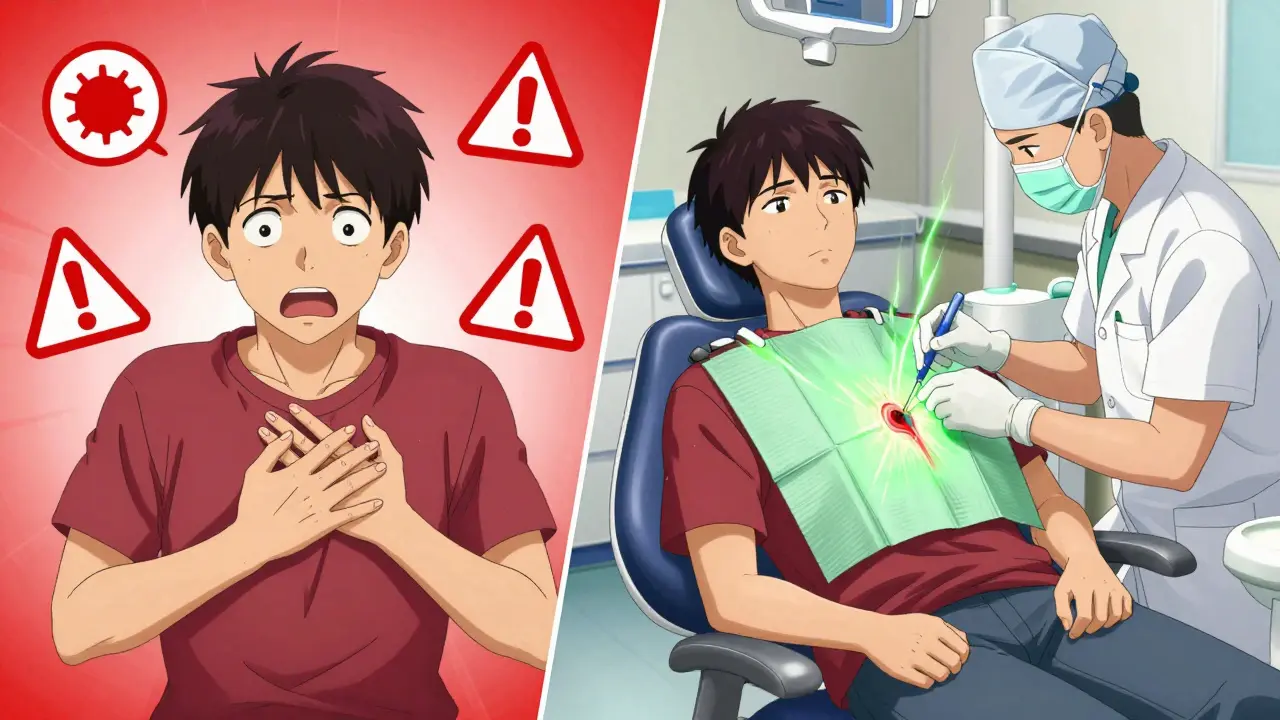
How Dentists Control Bleeding-Without Stopping Your Meds
Here’s the good news: dentists have powerful tools to stop bleeding without touching your blood thinner.
- Tranexamic acid mouthwash: A 5% solution used 4 times a day for 7 days cuts bleeding risk by 62%. It’s cheap, safe, and works like a charm.
- Oxidized regenerated cellulose (Surgicel®): A sponge-like material packed into the extraction socket reduces bleeding time by 47% compared to plain gauze.
- Microfibrillar collagen (Avitene®): Works like a magnet for blood cells, achieving hemostasis in over 92% of anticoagulated patients.
- Lidocaine with epinephrine: The local anesthetic with a vasoconstrictor reduces bleeding by 32% compared to plain lidocaine.
These aren’t experimental. They’re standard in modern dental offices. Ask your dentist if they use them. If they don’t, it’s a red flag.
What You Should Do Before Your Appointment
Here’s your simple checklist:
- Don’t stop your blood thinner. Ever. Not even for a single tooth.
- If you’re on warfarin: Get your INR checked within 72 hours before your appointment. Bring the result with you.
- If you’re on a DOAC: Skip your morning dose if your appointment is in the afternoon. If you’ve already taken it, still go. Tell your dentist.
- Ask your dentist: Do you use tranexamic acid mouthwash? Do you have Surgicel or Avitene on hand?
- Don’t take NSAIDs after. No ibuprofen, no naproxen. They double your bleeding risk. Use acetaminophen (Tylenol) instead.
And if your dentist says, “We need to stop your blood thinner,” ask for their source. The ADA, AHA, and ACC all say not to. If they’re still pushing it, get a second opinion.

Pain Relief, Antibiotics, and Hidden Risks
What you take after your procedure matters just as much as what you do before.
NSAIDs are a no-go. Ibuprofen, naproxen, celecoxib-they all interfere with platelets and can spike bleeding risk 3 to 6 times when combined with anticoagulants. Stick to acetaminophen. But even acetaminophen needs caution: if you’re taking more than 2 grams a day for over a week, your INR can rise. Monitor it.
Antibiotics can interact. Metronidazole (Flagyl) can boost warfarin’s effect by 33-50%. That’s dangerous. Azithromycin? Safe. Always tell your dentist what you’re on.
Proton pump inhibitors (PPIs) like omeprazole can increase bleeding risk with edoxaban (Savaysa). If you’re on this combo, talk to your doctor. Your dentist might need to delay implants or other bone-related work.
The Biggest Mistake Dentists Still Make
A 2022 survey of over 1,200 U.S. dentists found that 43.7% still stop warfarin for single-tooth extractions-even though guidelines have said not to for over 20 years. And what happens? Eighteen percent of those patients end up in the ER within 30 days with a clot. That’s not a complication. That’s a preventable disaster.
It’s not that dentists are careless. It’s that they’re not trained enough. That’s why places like the Cleveland Clinic saw a 67% drop in adverse events after they made INR checks and hemostatic protocols mandatory. Standardization saves lives.
The Future Is Here-And It’s Better
Technology is making this even safer. Portable INR monitors like CoaguChek® let dentists check your blood levels right in the chair in under a minute. No more waiting days for lab results. And new topical agents like recombinant factor VIIa gel are cutting bleeding time by over 60% in high-risk cases.
AI tools are also emerging. One algorithm from the University of Pennsylvania predicts bleeding risk with 89% accuracy by analyzing 17 factors-your INR, platelet count, procedure type, even your age and kidney function. It’s not science fiction. It’s happening now.
By 2027, 78% of dental practices in the U.S. are expected to have formal anticoagulant protocols in place. That’s up from just 42% in 2023. The message is clear: this isn’t optional anymore. It’s standard care.
Don’t let fear make you stop your blood thinner. You’re not alone. Thousands of people get dental work done safely every day while on anticoagulants. All it takes is the right knowledge-and a dentist who knows the guidelines.
Should I stop my blood thinner before a tooth extraction?
No. For single-tooth extractions, fillings, cleanings, and most routine procedures, stopping your blood thinner increases your risk of stroke or clot far more than the bleeding risk. Guidelines from the ADA, AHA, and ACC all recommend continuing anticoagulants. Bleeding can be controlled with local measures like tranexamic acid mouthwash or Surgicel®.
What if my INR is 4.0? Can I still get a tooth pulled?
An INR above 3.5 increases bleeding risk. For a single extraction, your dentist may delay the procedure until your INR is under 3.5. For multiple extractions or surgery, they may need to consult your doctor to temporarily adjust your dose. Never stop your medication without medical advice. Even at INR 4.0, you can still be treated safely with proper hemostatic techniques.
Can I take ibuprofen after a dental procedure if I’m on blood thinners?
No. Ibuprofen and other NSAIDs increase bleeding risk 3 to 6 times when combined with anticoagulants. Use acetaminophen (Tylenol) instead. If you need stronger pain relief, ask your dentist for alternatives like low-dose opioids or nerve-targeting medications that don’t affect clotting.
How long should I wait after taking Xarelto before a tooth extraction?
If you take rivaroxaban (Xarelto) once daily, wait at least 12-24 hours after your last dose. If you take it twice daily, wait 24-48 hours. For safety, skip your morning dose if your appointment is in the afternoon. Procedures done less than 4 hours after a dose have a much higher bleeding risk-up to 8.7%.
Do I need to see my doctor before a dental procedure if I’m on blood thinners?
Only if you’re having a high-risk procedure like multiple extractions or major surgery, or if your INR is above 3.5. For routine work, your dentist can manage it safely. But always tell your dentist what you’re taking. If they’re unsure, they may call your doctor. Don’t assume you need a clearance visit-most of the time, you don’t.