

Side Effect Tolerance Calculator
How much risk can you tolerate for side effects?
This tool helps you understand your personal tolerance threshold based on absolute risk numbers
Your Personal Tolerance Threshold
Based on your inputs, here's what matters to you:
Absolute risk: % chance of experiencing this side effect
What this means for your medication choice
Recommendation: This side effect is acceptable for you.
When you’re prescribed a new medication, your doctor doesn’t just hand you a pill and say, ‘Take this.’ If they’re doing their job right, they’re asking you: What matters most to you? Not just about curing the condition-but about how you’ll feel day to day. That’s where shared decision-making scripts for side effect trade-offs come in. It’s not about pushing a treatment. It’s about walking side by side with your doctor to choose what fits your life.
Why Side Effects Aren’t Just Numbers
Many patients hear phrases like ‘this side effect is rare’ or ‘most people tolerate it fine.’ But what does that really mean? If you’re one of the 1 in 10 people who gets dizzy from a blood pressure pill, ‘rare’ doesn’t help. You’re the one lying awake at 3 a.m., wondering if you should stop taking it. That’s why research shows patients understand risks better when they’re given absolute numbers: ‘There’s a 15% chance you’ll feel nauseous,’ not ‘the risk is reduced by 40%.’ A 2019 study in the Annals of Internal Medicine found that when doctors used absolute risk numbers instead of vague terms, patient comprehension improved by 37%. That’s huge. Because side effects aren’t abstract-they’re real. Nausea that makes you skip meals. Fatigue that cancels weekend plans. Weight gain that changes how you see yourself. These aren’t side notes in a medical chart. They’re life-altering.The SHARE Approach: A Simple Framework for Hard Conversations
The Agency for Healthcare Research and Quality (AHRQ) developed the SHARE Approach to make these conversations easier. It’s not a script you memorize-it’s a structure you adapt. Here’s how it works in real life:- Seek opportunities: Your doctor starts by asking, ‘Would you like to talk about your options?’ Not ‘This is what we’re prescribing.’
- Help explore options: They lay out the choices: take the statin, try a different drug, or manage it with diet and exercise. Each comes with its own set of risks and benefits.
- Assess your values: This is the key step. ‘Some people are okay with mild muscle aches if their cholesterol drops fast. Others won’t take any risk of that. What’s your line?’
- Reach a decision: Together, you pick the path that matches your priorities-not just what’s statistically best.
- Evaluate: ‘How’s it going?’ is asked weeks later, not ignored until the next refill.
The Three-Talk Model: When Side Effects Are Serious
For tougher choices-like chemotherapy, anticoagulants, or long-term antidepressants-the three-talk model works better. It’s built for high-stakes trade-offs:- Option talk: ‘Here are your three choices. One reduces your stroke risk by 60%, but has a 4% chance of serious bleeding. Another has less bleeding risk but only cuts stroke risk by 30%.’
- Preference talk: ‘If you had to choose between feeling a little tired every day or having a 1 in 25 chance of a major bleed, which would you pick?’
- Decision talk: ‘So we’re agreed-you’re willing to accept the bleeding risk to avoid a stroke. Let’s set up a plan to watch for signs.’

What Patients Really Say
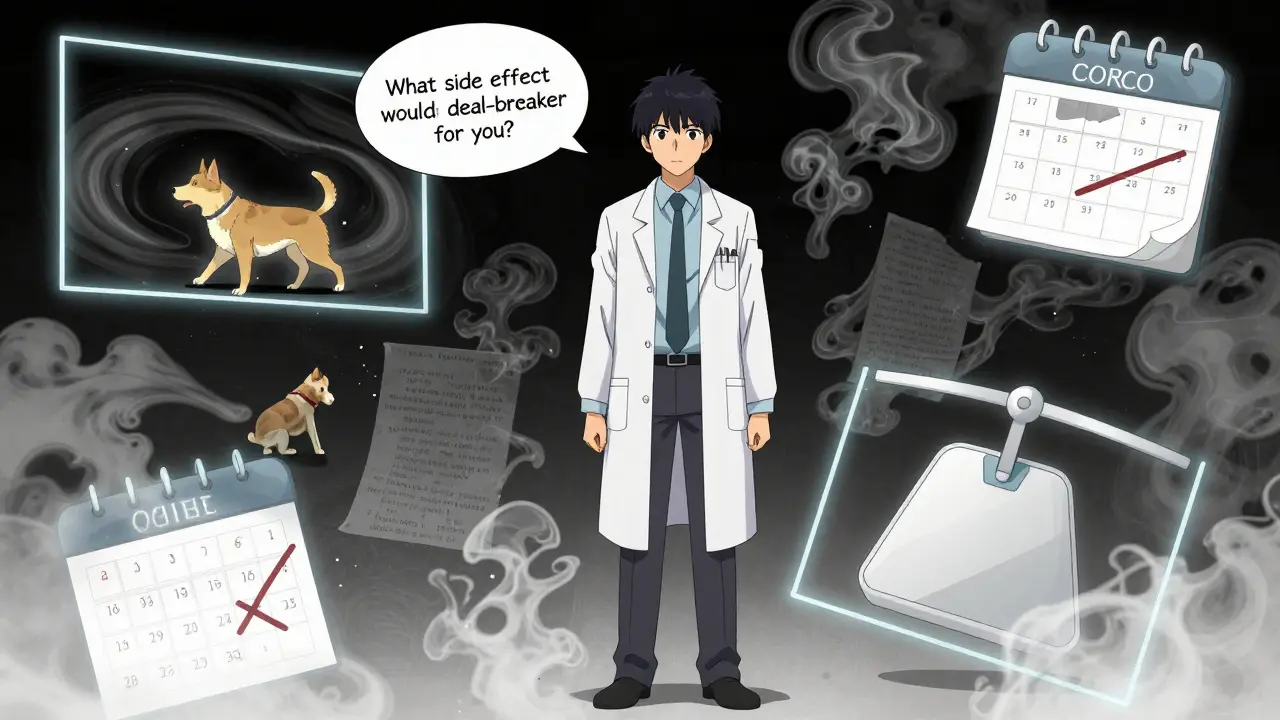
On Reddit’s r/medicine, one patient wrote: ‘My doctor didn’t just say ‘statins cause muscle pain.’ He asked, ‘Would you rather live with slightly higher cholesterol or have pain that stops you from walking your dog?’ That’s when I knew he got it.’ That post got over 140 upvotes. People aren’t just点赞-they’re sharing because they’ve been heard. A 2022 survey by the Informed Medical Decisions Foundation found that 84% of patients felt more confident in their choice when clinicians used structured tools. The most praised phrase? ‘What side effect would be a deal-breaker for you?’ That question flips the script. Instead of the doctor deciding what’s acceptable, the patient defines it. But here’s the flip side: 63% of patients in a Medscape survey said they felt frustrated when doctors read from scripts like robots. It’s not the framework that fails-it’s the delivery. If the conversation feels rehearsed, it feels cold. The best clinicians use the structure as a guide, not a script. They pause. They listen. They adjust.What Gets in the Way
Time. That’s the biggest barrier. A 2022 time-motion study at Scripps Health found that a full SDM conversation adds about 7.3 minutes to a visit. In a busy clinic, that’s a lot. But here’s the twist: those extra minutes save time later. Patients who make informed choices have 22% fewer follow-up visits because they’re not calling in panic about side effects they didn’t expect. Another problem? Training. Only 42% of primary care doctors have received formal training in shared decision-making. Most learned it on the job-or didn’t learn it at all. That’s changing. The American Medical Association now has CPT codes (96170-96171) that pay doctors $45-$65 for documented SDM sessions. That’s a real incentive. And then there’s the tech. Epic Systems, the biggest electronic health record vendor, rolled out built-in SDM modules in 2022. Now, when a doctor prescribes a statin, the system prompts them with a dropdown: ‘Did you discuss muscle pain risk and patient tolerance?’ It’s not perfect-but it’s pushing the standard forward.What Works Best
The most successful programs combine three things:- Pre-visit materials: A 5-minute video explaining side effect probabilities. Patients watch it at home. That cuts the in-clinic time by over 3 minutes.
- Visual aids: Color-coded charts showing risk levels. One study at Scripps found patient satisfaction jumped 41% when these were used.
- Trained clinicians: Doctors who’ve practiced role-playing hard conversations. At Massachusetts General Hospital, clinicians need 12 supervised sessions before they’re certified.
When It Doesn’t Work
Shared decision-making isn’t magic. It doesn’t belong in an emergency room. If you’re having a heart attack, you don’t want to debate whether to take aspirin. Time matters more than choice. It also falls flat when the doctor assumes they know what’s best. One patient told me: ‘My doctor said, ‘You’re young-you’ll be fine.’ But I was terrified of weight gain. He never asked.’ That’s not shared decision-making. That’s paternalism in a white coat. And it won’t work if the patient feels rushed, judged, or unheard. The goal isn’t to get them to say ‘yes.’ It’s to get them to say ‘this is right for me.’Where This Is Going
By 2026, AHRQ predicts 92% of major U.S. health systems will use some form of shared decision-making for side effect discussions. Medicare Advantage plans now require documentation of these conversations for high-risk meds. Insurance companies are paying for it. Hospitals are building it into their tech. Medical schools are teaching it. The future isn’t just about better scripts. It’s about smarter tools. The NIH just funded a $2.3 million project to build AI that listens to patient-clinician conversations and flags unspoken fears-like when someone says ‘I’m fine’ but their voice cracks. That’s the next frontier.What You Can Do
If you’re facing a medication decision:- Ask: ‘What are the side effects that actually matter to people?’
- Ask: ‘What’s the chance I’ll get each one?’
- Ask: ‘Which side effect would make you stop taking this?’
- Ask: ‘What happens if I wait or try something else?’
What is shared decision-making in healthcare?
Shared decision-making is a process where patients and clinicians work together to choose a treatment based on both medical evidence and the patient’s personal values, concerns, and lifestyle. It’s not about the doctor deciding for you-it’s about you being an equal partner in the choice, especially when treatments have trade-offs like side effects.
Why are absolute risk numbers better than relative risk?
Relative risk sounds impressive-‘reduces risk by 50%’-but it can be misleading. Absolute risk tells you the real chance: ‘15 out of 100 people get this side effect.’ That’s clearer. A 2019 study showed patients understood risks 37% better when absolute numbers were used, helping them make choices based on actual likelihood, not percentages.
What’s the difference between the SHARE Approach and the three-talk model?
The SHARE Approach is a five-step framework good for routine decisions like starting a statin or blood pressure pill. The three-talk model is sharper, designed for high-stakes choices like cancer treatment or anticoagulants. SHARE focuses on guiding the conversation; three-talk dives deep into weighing specific risks against personal values.
Do I have to agree with my doctor’s recommendation?
No. Shared decision-making means you have the final say. Your doctor’s job is to explain the options, risks, and benefits clearly. Your job is to say what matters to you. If a side effect would ruin your quality of life, you’re allowed to say no-even if the drug is ‘best’ on paper.
How long does a shared decision-making conversation take?
A full conversation typically adds 7 to 10 minutes to a regular appointment. But it often reduces later visits because patients are better prepared. Some clinics use pre-visit videos to cut that time in half. The goal isn’t speed-it’s clarity.
What if my doctor doesn’t use shared decision-making?
You can still ask for it. Try saying, ‘I’d like to understand the trade-offs better. Can we talk about what side effects matter most to me?’ Most doctors will respond positively. If they push back or seem annoyed, it might be time to find one who listens. Your care should be a team effort.