
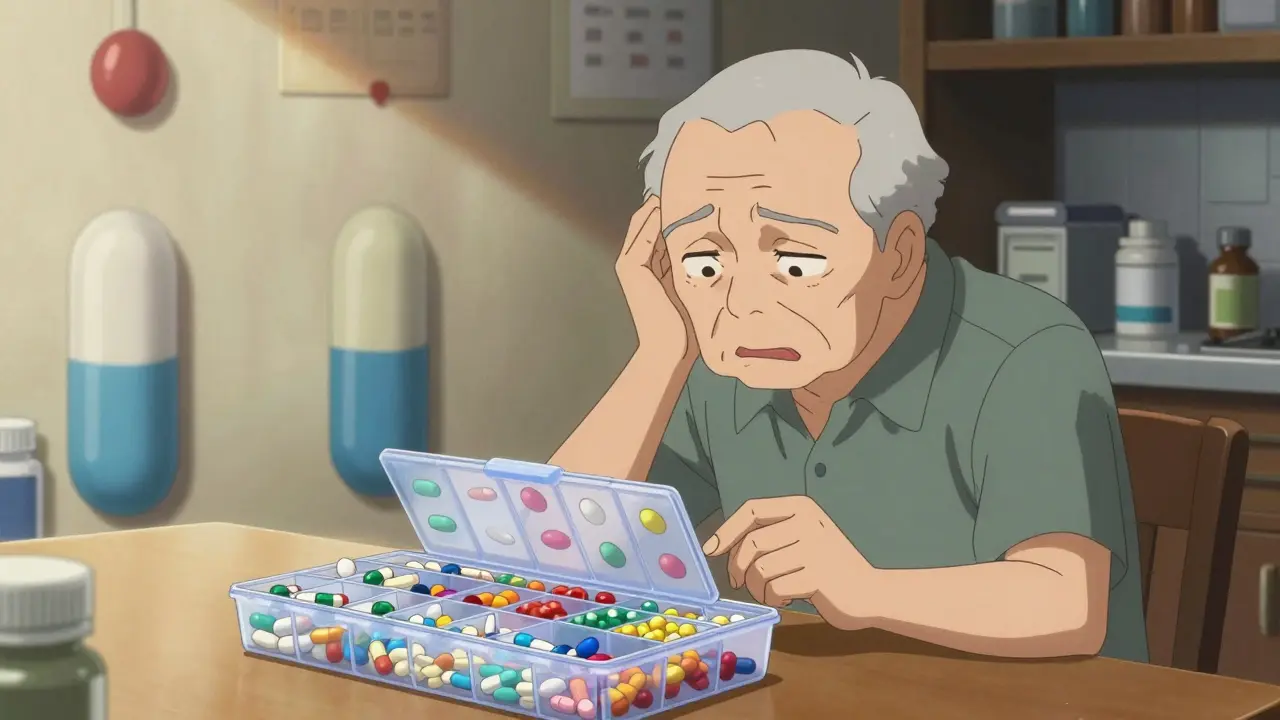
The Hidden Danger of Too Many Pills
Every time you look at a pill organizer filled to the brim, there is a question that often goes unasked. Is every single tablet here actually necessary? This is the core issue behind polypharmacy, defined clinically as the regular concurrent use of five or more medications. While older adults may take multiple prescriptions for good reason-managing heart disease, diabetes, or arthritis-the accumulation creates a perfect storm for health risks. In fact, inappropriate polypharmacy affects approximately 40% of older adults globally. This isn't just about taking too many pills; it is about how those pills interact within a changing body.
The human body does not handle medication the same way at seventy-five as it does at thirty. By the time we reach our eighties, liver metabolism can drop by up to 50%, meaning drugs stay in the system longer than intended. Kidney function declines roughly 1% every year after age 40. These shifts mean a dosage safe for a forty-year-old can become toxic for an eighty-year-old, leading to adverse drug events that account for 10% of all hospital admissions in people over 65. When we fail to adjust for these biological realities, the cost is high-not just financially, with healthcare costs exceeding billions annually, but physically.
| Body System | Change in Aging | Clinical Impact |
|---|---|---|
| Liver Metabolism | Decreased by 30-50% | Slower breakdown of active drugs |
| Kidney Function | Drops ~1% per year after 40 | Increased toxicity and retention |
| Body Fat Ratio | Increases relative to muscle | Fat-soluble drugs accumulate longer |
Identifying Risky Medications in Senior Care
Not every list of ten medications is dangerous, but certain classes pose higher risks when combined. Medical experts rely on tools like the American Geriatrics Society Beers Criteria to spot red flags. This list identifies 56 specific drugs or classes that increase harm potential for adults over 65. For instance, benzodiazepines are widely prescribed for anxiety or sleep, yet they raise fall risk by 50%. A fall for a young person might result in a bruise; for a senior, it often means a hip fracture or head trauma, accounting for 35% of emergency visits.
Another common culprit is non-steroidal anti-inflammatory drugs (NSAIDs). Many seniors reach for ibuprofen for chronic pain without realizing that long-term use increases gastrointestinal bleeding risk by 2.5 times. Similarly, anticholinergic medications, often found in sleeping pills or allergy treatments, have been correlated with a 1.5-fold increased risk of developing dementia over seven years. These aren't rare side effects; they are predictable outcomes of systemic prescribing habits that haven't kept pace with our understanding of geriatric physiology.

The Process of Deprescribing
If the problem is taking too much, the solution is deprescribing. This term describes the systematic process of discontinuing medications when potential harms outweigh benefits. It is not about stopping treatment abruptly; it is a strategic withdrawal managed by healthcare teams. Studies show that appropriate deprescribing can reduce adverse drug events by 22% and cut hospital admissions by 17%. To do this effectively, doctors and families need to move away from thinking of each pill as an isolated fix and view them as part of a cohesive ecosystem.
A landmark approach to this involves prioritizing high-risk medications first. Opioids, for example, are associated with a 300% increased fall risk in older adults due to dizziness and impaired balance. If a senior has taken an opioid for chronic back pain for five years, it requires a careful tapering plan rather than cold turkey cessation. Best practices dictate education for the patient and their advocates. You cannot successfully stop a medication if the patient fears their condition will return immediately. Trust building between the doctor, pharmacist, and family is the foundation of successful deprescribing.
Practical Steps for Families and Caregivers
You might wonder how you can help a parent or partner navigate this issue. The first step is simple but rarely done: the "brown bag review." Bring every bottle, box, and supplement to the next appointment. Specialists often don't see the full picture because they only manage one condition. An ophthalmologist sees eye pressure, while a cardiologist monitors blood pressure, creating fragmented regimens where one specialist prescribes something another didn't know was there. Research shows this brown bag technique typically identifies nearly three unnecessary or duplicate medications per patient.
Communication is equally critical. Only one-third of older adults specifically discuss decision-making priorities with their doctors regarding medications. This disconnect leaves treatment plans focused on disease metrics rather than quality of life goals. Does the medication improve daily living, or just lower a number on a chart? Establishing clear goals of care shifts the focus from aggressive treatment of every symptom to maintaining dignity and independence. If a blood thinner increases bleeding risk so much that the fear of falling prevents walking, the benefit needs re-evaluation.
- Inventory Everything: List prescription drugs, over-the-counter remedies, vitamins, and herbal supplements.
- Schedule Regular Reviews: Set calendar reminders for quarterly medication checks during routine check-ups.
- Question New Prescriptions: Ask if a new drug could replace an old one instead of adding to the stack.
- Monitor Side Effects: Track symptoms like drowsiness, dizziness, or confusion and report them immediately.

Systemic Barriers and Solutions
Often, polypharmacy persists not because doctors want to hurt patients, but because the healthcare system encourages reactive prescribing. Transitions of care-moving from hospital to home-are high-risk times. Dr. Gurvich of UCI Health noted cases where patients ended up with three times as many meds as needed because nobody told them to discard old ones upon discharge. Medication reconciliation failures account for 50% of post-discharge complications. Technology helps bridge this gap. Electronic health records now generate alerts for drug-drug interactions, though they suffer from high false alarm rates requiring human judgment to interpret.
Funding initiatives are beginning to address this. In early 2023, the Centers for Medicare & Medicaid Services launched specific programs to fund standardized deprescribing protocols across health systems. These efforts aim to make comprehensive medication reviews the norm rather than the exception. In academic centers, tools like the Medication Regimen Complexity Index are now adopted in two-thirds of facilities to objectively measure burden.
Looking Forward in Medication Management
The field is moving toward personalized care models. The concept of treating everyone over 65 the same way is fading. We are seeing the rise of geropharmacogenomics, which looks at individual genetic profiles to predict how a specific person metabolizes drugs. Early projections suggest this could halve adverse drug events in genetically profiled patients. Additionally, digital health platforms are integrating pharmacogenomic data to predict interactions before a patient even takes the first dose.
This evolution represents a shift from quantity-focused definitions to quality-focused "appropriate prescribing" metrics. As the population continues to age-with 21% projected to be over 65 by 2030-the stakes for getting this right continue to rise. The goal remains consistent: optimizing therapy so that medications serve the patient, rather than the patient serving the medication regimen.
Is polypharmacy always bad?
Not necessarily. Taking multiple medications is sometimes required for complex conditions. The danger lies in "inappropriate polypharmacy," where medications provide no benefit or cause harm that outweighs the therapeutic gain.
What is the Beers Criteria?
It is a list published by the American Geriatrics Society that identifies medications potentially inappropriate for older adults due to safety concerns like fall risk or kidney damage.
Can I stop medication without asking a doctor?
Never stop medications abruptly. Doing so can cause withdrawal symptoms or rebound conditions. Always work with a professional to create a tapering schedule.
How often should older adults review their meds?
Experts recommend reviewing all medications at every healthcare transition, such as hospital discharge, and conducting comprehensive annual audits with a pharmacist or geriatrician.
Does vitamin supplements count as medication?
Yes, supplements interact with prescriptions chemically. They should be included in any "brown bag" review to prevent hidden interactions.


