
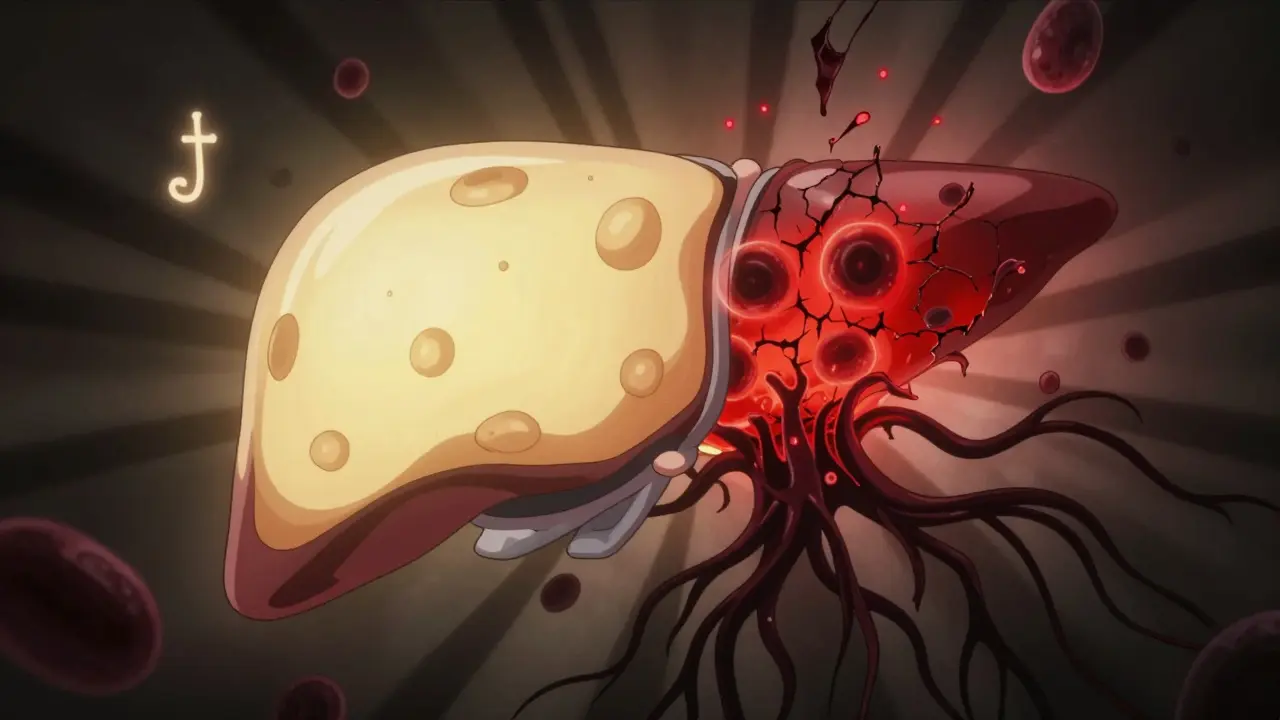
When doctors say you have a fatty liver, it’s not just one condition - it’s a spectrum. At one end is simple fat buildup, harmless for most. At the other is a dangerous, progressive disease that can lead to cirrhosis, liver cancer, or death. The difference? NASH. And knowing which one you have changes everything.
What’s the real difference between NAFLD and NASH?
NAFLD - Non-Alcoholic Fatty Liver Disease - sounds like a single diagnosis. But it’s actually two conditions wrapped into one label. One is called NAFL: fat in the liver (5% or more), but no damage. The other is NASH: fat plus inflammation and injured liver cells. That’s the line between a warning sign and a ticking time bomb.
Think of it like plaque in your arteries. Some buildup is normal with age. But when it starts swelling, tearing, and triggering inflammation - that’s when heart attacks happen. Same with the liver. Fat alone? Usually fine. Fat plus inflammation? That’s when the liver starts scarring itself to death.
The American Association for the Study of Liver Diseases (AASLD) and European liver groups updated the terminology in 2023. NAFLD is now called MASLD (Metabolic Dysfunction-Associated Steatotic Liver Disease), and NASH is now MASH (Metabolic Dysfunction-Associated Steatohepatitis). The change isn’t just semantics - it removes the outdated "non-alcoholic" label and focuses on what really drives the disease: metabolic dysfunction. That means obesity, diabetes, high blood pressure, and bad cholesterol are the root causes, not just "not drinking."
How do you know if you have NASH - not just NAFL?
Most people with fatty liver have no symptoms. Fatigue? Mild belly discomfort? These are vague and often ignored. That’s why so many are diagnosed late - after fibrosis has already started.
Doctors start with blood tests. ALT and AST are liver enzymes. If ALT is above 40 U/L (or AST above 48 U/L), that’s a red flag. But normal numbers don’t rule out fatty liver. You can have 30% fat in your liver and still have normal enzymes.
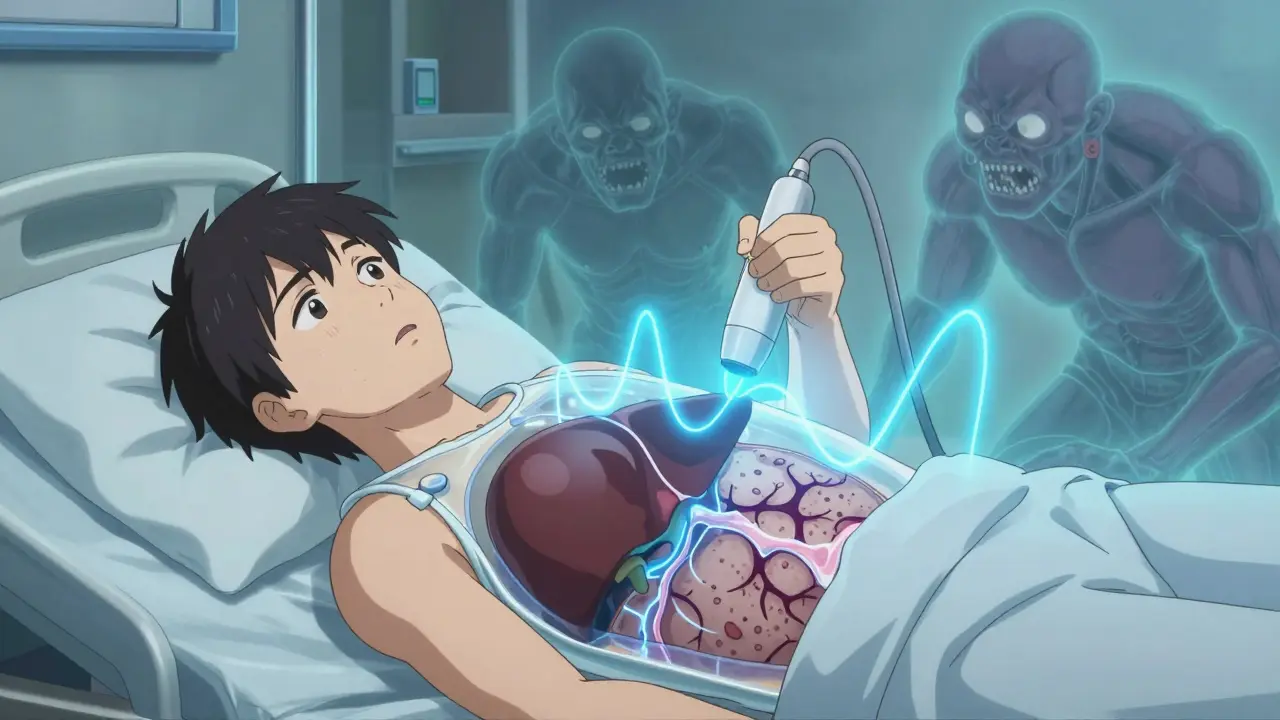
Next, imaging. Ultrasound is common, cheap, and catches fat when it’s over 20-30% of the liver. But it can’t tell if there’s inflammation or scarring. MRI-PDFF is more accurate - it measures fat percentage precisely, down to the 1%. But it’s expensive and not widely available.
Then there’s FibroScan - a quick, painless test that measures liver stiffness. A reading above 7.1 kPa suggests fibrosis. Above 10 kPa? High risk of advanced scarring. This is becoming the go-to tool for primary care doctors, especially since liver biopsy is only done in high-risk cases.
Liver biopsy is still the gold standard. Only about 10-15% of people with suspected fatty liver need one. But if your doctor recommends it, they’re looking for two things: ballooning liver cells (a sign of injury) and inflammation. No ballooning? You likely have NAFL. Both? You have NASH.
Fibrosis staging: The real predictor of your future
Here’s the cold truth: It’s not NASH that kills you - it’s fibrosis. A 2022 study from the European Association for the Study of the Liver found that patients with stage 3 or 4 fibrosis had a 12-25% chance of dying from liver disease within 10 years. Those with stage 0-2? Less than 2%.
Fibrosis is scored from 0 to 4:
- Stage 0: No scarring. Safe.
- Stage 1: Scarring around blood vessels. Mild risk.
- Stage 2: Scarring spreading inward. Moderate risk.
- Stage 3: Bridging fibrosis - scars start connecting. High risk.
- Stage 4: Cirrhosis. The liver is hardened, shrunken, and failing.
Here’s what the data shows: 41.7% of NASH patients develop advanced fibrosis over 15 years. Only 12.3% of NAFL patients do. That’s more than triple the risk. And once you hit stage 3, your chances of liver cancer jump. About 5-12% of NASH patients develop hepatocellular carcinoma (HCC) within 10-20 years. That’s why fibrosis stage matters more than whether you’re labeled "NASH."
Who’s at risk - and why?
You don’t have to be overweight to get NASH, but it’s rare if you’re not. Here’s who’s most at risk:
- Obesity (BMI ≥30): 70-90% of NASH patients have it.
- Type 2 diabetes: 50-70% of NASH cases. Insulin resistance literally feeds fat into the liver.
- Hypertension: 60-75% of NASH patients. High blood pressure damages small liver vessels.
- Obstructive sleep apnea: 30-50% of NASH cases. Poor oxygen at night triggers liver inflammation.
And here’s the kicker: you don’t need all four. Just two - say, diabetes and high blood pressure - and your risk doubles. This is why doctors now screen for metabolic syndrome: three or more of these five factors - waist size over 40 inches (men) or 35 inches (women), triglycerides ≥150 mg/dL, HDL below 40 (men) or 50 (women), blood pressure ≥130/85, and fasting glucose ≥100 mg/dL.
One 2022 study found that people with metabolic syndrome and elevated ALT had a 6x higher chance of having advanced fibrosis than those without.
What actually works - and what doesn’t
There’s no magic pill. Yet. But there’s one treatment that works better than any drug: weight loss.
Studies show that losing 7-10% of your body weight reverses NASH in 90% of cases. It also improves fibrosis in 85%. That’s not a guess - it’s from the 2023 International NASH Registry, tracking over 5,000 patients.
How? Fat doesn’t just sit in your liver - it triggers inflammation. Lose the fat, and the inflammation calms down. Liver cells heal. Scarring can even reverse.
Exercise alone helps too - even without weight loss. 150 minutes a week of moderate activity (brisk walking, cycling) cuts liver fat by 20% in 6 months.
What doesn’t work? Supplements. Milk thistle? Vitamin E? Omega-3s? Some show mild benefit in small studies, but nothing consistent. And no, cutting out sugar alone isn’t enough. It’s total calorie reduction and metabolic reset.
Now, the first FDA-approved drug for NASH - resmetirom (Rezdiffra) - got approval in March 2023. It’s for patients with moderate to advanced fibrosis. In trials, 26% saw fibrosis improvement versus 10% on placebo. It’s not a cure. But it’s a start.

Why most people get diagnosed too late
Here’s the broken system: primary care doctors see 30-40 patients a day. They don’t have time to dig into liver enzymes unless someone is jaundiced or vomiting. So people go years with elevated ALT, no diagnosis, no intervention.
A 2022 survey by the American Gastroenterological Association found that 41% of patients waited 6 to 24 months between abnormal liver tests and specialist referral. That’s a huge window for fibrosis to creep in.
And here’s another problem: non-invasive tests aren’t perfect. FibroScan misses fibrosis in 15% of cases. FIB-4 scores (calculated from age, ALT, AST, platelets) can be wrong if you’re young or have low platelets. That’s why biopsy is still needed for confirmation - especially if your score is borderline.
One Reddit user, "LiverWarrior2022," shared: "My ALT was 68 for three years. No symptoms. Then I got a FibroScan - stage 2 fibrosis. I had no idea."
What’s next? The future of fatty liver care
By 2030, NASH-related liver transplants are expected to rise from 10% to 25% of all transplants in the U.S. That’s not a prediction - it’s based on UNOS data tracking current trends.
But there’s hope. The 2023 AASLD-EASL guidelines now recommend screening all adults with obesity or diabetes. That’s a game-changer. If we catch it early - before fibrosis - we can stop it.
Three drugs are in phase 3 trials: cenicriviroc, lanifibranor, and another version of resmetirom. They target inflammation, fibrosis, and metabolism. One might be approved by 2027.
But drugs won’t fix this epidemic. Only lifestyle change will. And that starts with knowing: Is it just fat? Or is it damage? Because once fibrosis starts, you’re playing catch-up. The sooner you act, the better your liver - and your life - will be.
Can NAFLD turn into NASH even if I’m not overweight?
Yes, though it’s rare. About 10-15% of NASH patients have normal weight. These are often people with genetic risks, insulin resistance without obesity, or metabolic dysfunction from other causes like polycystic ovary syndrome (PCOS) or rapid weight cycling. Even thin people with high triglycerides or diabetes can develop NASH.
If I have NAFL, do I need to worry?
You should monitor it, but not panic. NAFL has very low progression risk - only about 1 in 8 people develop fibrosis over 15 years. But if you have diabetes, high blood pressure, or high cholesterol, your risk jumps. The key is to control those conditions. Lose weight if you can. Exercise. Avoid added sugar and refined carbs. That’s usually enough to keep NAFL from turning into NASH.
Is NASH reversible?
Yes - if caught early. Studies show that losing 7-10% of body weight can reverse NASH in 90% of cases and improve fibrosis in 85%. The liver is resilient. If you stop the damage (fat, sugar, inflammation), it can repair itself. But once you reach stage 3 or 4 fibrosis, reversal becomes unlikely. That’s why early action matters.
Can I get NASH from drinking alcohol?
No - by definition. NASH (and NAFLD) are diagnosed only in people who drink little to no alcohol. If alcohol is the cause, it’s called alcoholic fatty liver disease. But many people with NASH also drink lightly, which can worsen liver damage. Doctors usually set a cutoff: less than 30 grams of alcohol per day for men (about 2 drinks), less than 20 for women.
Should I get a liver biopsy if I’m told I have NASH?
Not always. Biopsy is only recommended if non-invasive tests (FibroScan, FIB-4, MRI) suggest advanced fibrosis, or if there’s uncertainty. It’s invasive and carries a small risk. But if your doctor says you have NASH based on blood tests and imaging alone - and you’re not at high risk - biopsy may not be needed. The goal is to avoid unnecessary procedures, not to confirm every diagnosis.


