
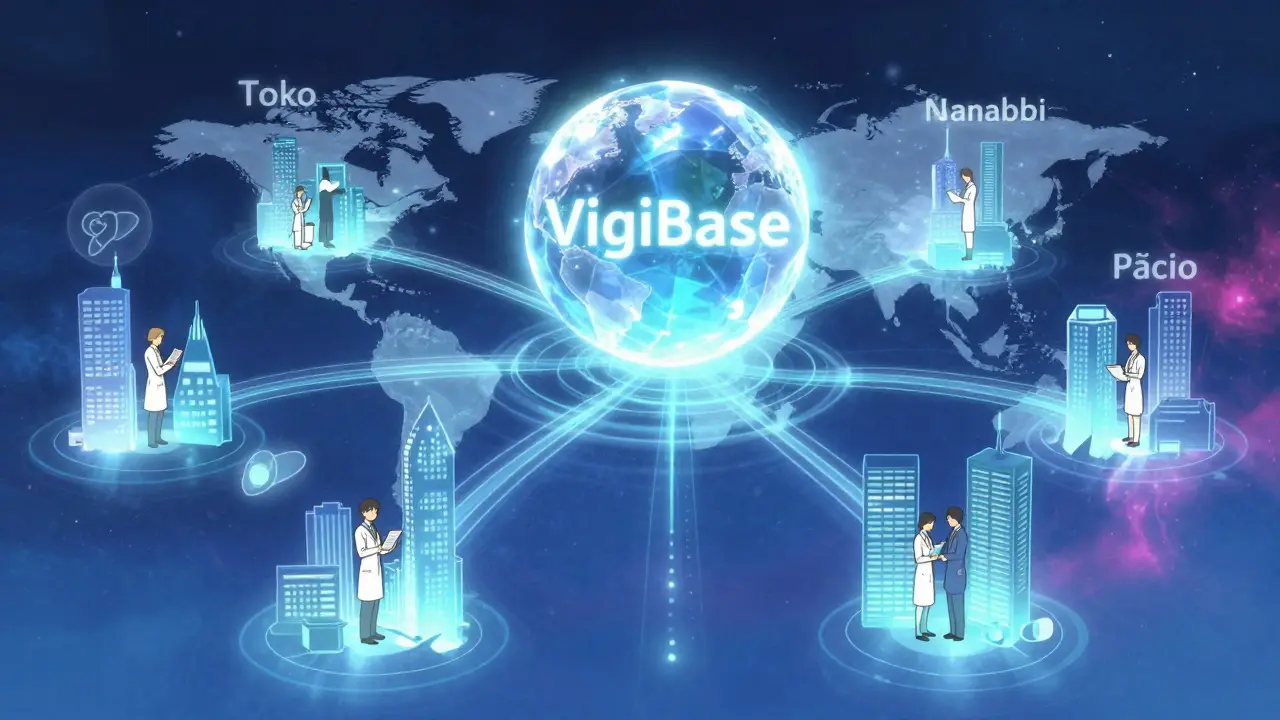
Every time someone takes a medicine, there’s a quiet system working behind the scenes to make sure it’s still safe. That system is drug safety monitoring, and it’s not just a national job-it’s a global one. When a new side effect pops up in Brazil, Japan, or South Africa, that information doesn’t stay local. It gets sent to a central hub that connects over 170 countries. This is how we catch dangerous drugs before they hurt millions.
How the Global Drug Safety Network Works
The backbone of international drug safety monitoring is the WHO Programme for International Drug Monitoring (PIDM), a global network coordinated by the World Health Organization since 1968 to collect and analyze reports of adverse drug reactions. It’s not a fancy lab or a high-tech supercomputer. It’s a network of national centers in countries big and small, all sending in reports about unexpected side effects from medicines.These reports are called Individual Case Safety Reports, or ICSRs. Each one is a snapshot: which drug was taken, what side effect happened, who took it, and when. The system uses strict formats like E2B(R3) so every report, no matter where it comes from, can be read the same way. The data is stored in VigiBase, the world’s largest database of adverse drug reaction reports, managed by the Uppsala Monitoring Centre in Sweden. As of 2023, it held over 35 million reports-up from just 5 million in 2012.
Behind the scenes, medical terms are standardized using MedDRA, a dictionary with over 78,000 terms that turns vague descriptions like ‘feeling dizzy’ into precise medical language. Drugs are labeled using WHODrug Global, a dictionary with more than 300,000 medicine names across 60+ categories. This lets analysts spot patterns. If 50 people in different countries report liver damage after taking the same new painkiller, that’s a signal. And signals trigger investigations.
Regional Systems: EU, U.S., and the Rest
Not every country plays by the same rules. The European Union’s EudraVigilance, a mandatory system under EU law that requires drug companies to report adverse events within 15 days, is faster and more tightly controlled. The EU’s Pharmacovigilance Risk Assessment Committee (PRAC), a panel of experts that reviews signals and can recommend drug restrictions or withdrawals, has legal power to act. In the EU, 92% of high-priority signals are reviewed within 75 days.In the U.S., the Food and Drug Administration’s FAERS, a system that receives about 2 million reports per year, mostly from patients and doctors, operates independently. It doesn’t feed directly into VigiBase, but many U.S. reports are shared manually. The FDA can issue warnings or pull drugs, but its process is slower and less integrated than the EU’s.
Meanwhile, the WHO system doesn’t have enforcement power. It doesn’t ban drugs. It doesn’t fine companies. It just collects data and raises flags. That’s its strength and its weakness. It can spot problems in places where no other system exists-like a rare reaction to a malaria drug in rural Tanzania. But it can’t force a country to act.
The Big Gap: Who Reports, and Who Doesn’t
Here’s the uncomfortable truth: the global system is skewed. Countries with high incomes-home to just 16% of the world’s population-submit 85% of all reports to VigiBase. Sweden reports about 1,200 adverse events per 100,000 people each year. Nigeria? Around 2.3 per 100,000.Why? Money, training, and infrastructure. In many low-income countries, there’s no dedicated budget for drug safety. A WHO survey found that 50 African nations averaged just $0.02 per person spent on pharmacovigilance. In Australia or Germany, it’s over $1.20. That’s not a typo. It’s 60 times less.
Many health clinics in places like Ethiopia or Bangladesh still rely on paper forms. Getting those forms to a central office can take months. The Pharmacovigilance Monitoring System (PViMS), a web-based tool developed by MTaPS to help low-resource countries report electronically, helped Ethiopia cut reporting time from 90 days to 14. But even then, only 35% of health facilities submit reports regularly because of poor internet.
Training is another issue. WHO recommends 40 hours of specialized training for pharmacovigilance officers. In Southeast Asia, 68% of officers got less than 15 hours. Without proper training, side effects get missed, misclassified, or ignored.
How Technology Is Changing the Game
The old way of monitoring drug safety relied on people noticing something strange and filling out a form. That still happens. But now, technology is adding layers.In the EU, active surveillance uses electronic health records from 150 million patients. Instead of waiting for a report, systems automatically scan for patterns-like a spike in heart rhythm issues after a new antibiotic was prescribed. This method improved signal detection by 37% compared to passive reporting.
Artificial intelligence is now being used by the Uppsala Monitoring Centre to sort through millions of reports. A 2023 study showed AI cut false alarms by 28%. That means analysts spend less time chasing ghosts and more time investigating real threats.
Public access is growing too. VigiAccess, a free public portal launched in 2015 that lets anyone search anonymized data from VigiBase, has had over 12 million visits. Patients, doctors, and researchers now use it to check if a drug has been linked to rare side effects in other countries.
What’s Next? Standards, AI, and Global Equity
The future of drug safety monitoring hinges on two things: better data and fairer access.By 2025, countries will start using ISO IDMP, a new global standard that defines medicines with 100+ precise data points-name, strength, manufacturer, formulation, and more. Right now, a drug called “Metformin 500mg” might be listed differently in 10 countries. With IDMP, every system will know it’s the exact same pill. That could improve cross-border matching by 40%.
For vaccines, progress is faster. Since 2020, 45 low- and middle-income countries have adopted electronic vaccine safety tools. Reporting time dropped from 60 days to 7. That’s huge for catching rare reactions like the dengue hemorrhagic fever linked to Dengvaxia in the Philippines-first spotted through local reports.
But sustainability remains a problem. One-third of low-income country systems depend on donor funding. If that money disappears, the system collapses. And without those reports, global safety misses critical signals.
Why This Matters to You
You might think, “I take my medicine. I don’t need to know about databases and reports.” But here’s the truth: the safety of your next prescription depends on this system.When a new cancer drug causes unexpected liver damage in 3 patients in Germany, the system detects it. When a cheap antibiotic causes seizures in children in India, it’s flagged. When a vaccine triggers a rare neurological reaction in Brazil, it’s shared globally.
That’s how we avoid another thalidomide. That’s how we catch problems before they become epidemics. That’s how a drug that’s safe in one country doesn’t become dangerous in another.
Drug safety monitoring isn’t glamorous. It doesn’t make headlines. But every time you take a pill and don’t get sick because of a hidden side effect, that’s the system working.
What is the main purpose of international drug safety monitoring?
The main purpose is to detect and respond to previously unknown or rare side effects of medicines after they’ve been approved and used by large populations. It helps protect public health by ensuring that the benefits of a drug continue to outweigh its risks over time.
How does VigiBase differ from the FDA’s FAERS?
VigiBase is a global, voluntary database managed by the WHO, collecting reports from over 170 countries. FAERS is a U.S.-only system run by the FDA, focused on reports within the United States. VigiBase has broader geographic coverage, while FAERS has deeper data from a single high-income country. Some FAERS reports are shared with VigiBase, but they operate separately.
Why do high-income countries report more adverse drug reactions?
They have better infrastructure: trained staff, electronic reporting systems, public awareness campaigns, and funding. In many low-income countries, there’s no budget for pharmacovigilance, no internet access in clinics, and little training for health workers. This doesn’t mean fewer side effects occur-it means fewer are reported.
Can patients report adverse drug reactions themselves?
Yes. In many countries, including the U.S., Canada, Australia, and across Europe, patients can report side effects directly through online portals, mobile apps, or phone lines. In the UK’s Yellow Card Scheme, 78% of reports come from healthcare professionals, but patients can and do submit reports too.
What happens when a safety signal is confirmed?
If a signal is confirmed as a real risk, regulators can take action: update the drug’s label with new warnings, restrict its use to certain patients, require additional studies, or withdraw it from the market. In the EU, PRAC can recommend these actions within 60 days for priority signals. In other countries, the process may take longer or require political approval.
Is artificial intelligence replacing human analysts in drug safety monitoring?
No. AI helps filter through millions of reports to find the most concerning patterns, reducing false alarms by nearly a third. But human experts still review each potential signal, assess the evidence, and decide if action is needed. AI is a tool, not a replacement.
How can low-income countries improve their drug safety systems?
They need investment in training, digital tools like PViMS, reliable internet access, and sustainable funding. Partnerships with global organizations and donor programs can help, but long-term success requires national commitment-making pharmacovigilance part of public health law and budgeting, not just a temporary project.
Final Thoughts
International drug safety monitoring is one of the quietest, most effective public health systems ever built. It doesn’t need a parade. It doesn’t need a viral TikTok. It just needs consistent reporting, good data, and global cooperation.The next time you hear about a drug being pulled from shelves or a warning added to a label, know this: it didn’t happen by accident. It happened because someone in a clinic in Manila, a pharmacist in Nairobi, or a nurse in Kyiv reported a strange reaction-and the system listened.


