
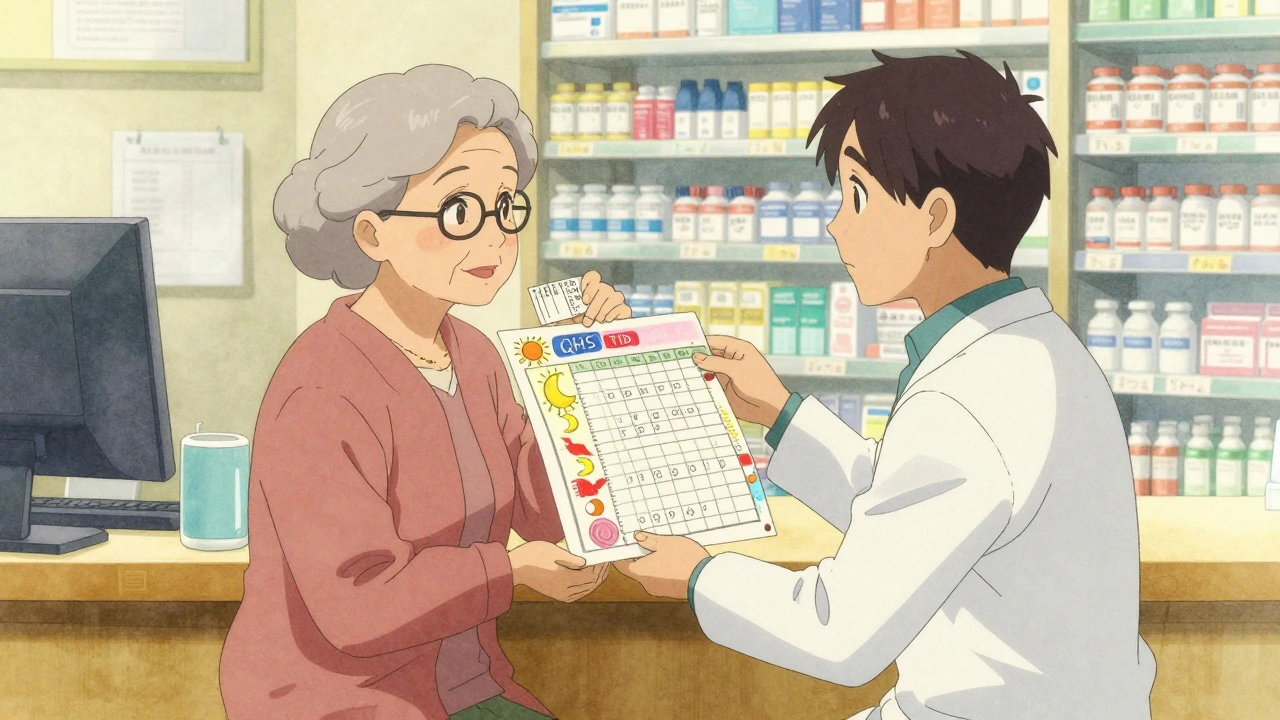
Every year, millions of people in the U.S. take their medications wrong-not because they’re careless, but because the instructions they were given don’t make sense. You might get a small paper slip with tiny print, medical terms like "take QHS" or "TID," and no explanation of what that actually means. If you’ve ever stared at your pill bottle wondering if you’re doing it right, you’re not alone. And here’s the truth: you have the right to get written instructions you can actually understand.
You Don’t Have to Guess What the Instructions Mean
Pharmacies and doctors aren’t required by federal law to give you clear, easy-to-read written instructions with your prescriptions. That’s not a myth-it’s a fact. The Institute for Safe Medication Practices found that 63% of medication errors happen because patients didn’t understand what they were supposed to do. That’s not your fault. It’s a system failure. You shouldn’t have to memorize Latin abbreviations or Google "QD" just to know if you’re supposed to take your pill in the morning or at night.But here’s the good news: even without a federal law, you have rights. The American Medical Association says you have the right to ask questions and get answers you understand. The Patient Bill of Rights used by hospitals and pharmacies across the country guarantees you can receive information in a way you can understand. That includes written instructions. You’re not asking for a favor-you’re claiming a right.
What Makes Instructions Actually Understandable?
Not all written instructions are created equal. A page full of medical jargon doesn’t count as clear. Understandable instructions look like this:- "Take one pill every morning with breakfast" instead of "Take one tablet PO QD."
- "Do not drink alcohol while taking this medicine" instead of "Avoid concomitant ethanol ingestion."
- A simple chart showing days of the week with boxes to check off when you’ve taken your pills.
- Icons or pictures-like a sun for morning, a moon for night, or a broken pill for split doses.
- Clear warnings in bold: "This medicine can make you dizzy. Don’t drive until you know how it affects you."
Canada and the UK require all prescription labels to be written at a 6th-grade reading level. In the U.S., most instructions are written at a 10th- or 11th-grade level-way too high for nearly half of American adults. You shouldn’t need a college degree to take your medicine safely.
How to Ask for Better Instructions (Step by Step)
Asking for better instructions isn’t about being difficult. It’s about being smart. Here’s how to do it effectively:- Ask to speak with the pharmacist, not just the technician. Technicians often just print labels. Pharmacists are trained to explain medications. At chain pharmacies, 73% of policies require technicians to hand off these kinds of questions to a pharmacist.
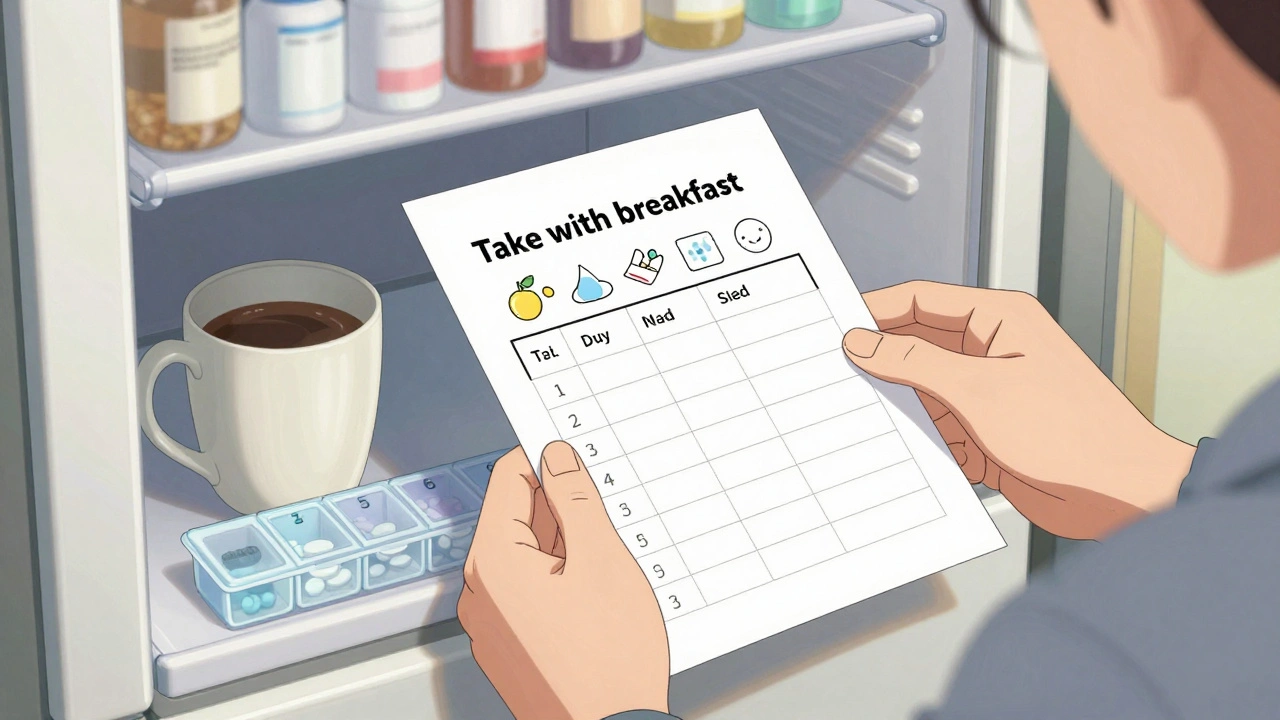
- Be specific. Don’t say, "Can you make this easier?" Say: "I need this written in plain English, not medical terms. Can you give me a one-page summary I can keep on my fridge?"
- Cite your rights. Say: "I’m exercising my right under the AmerisourceBergen Patient Rights document to receive education in a language I understand." Or: "According to Tennessee Oncology’s Patient Bill of Rights, I have the right to receive information in a manner that is easily understood." Using exact language like this increases your chances of getting help by 3.7 times.
- Ask for visuals. Say: "Can you give me a picture schedule?" Studies show visual charts improve adherence by 42% for people on multiple medications.
- Do a read-back. After they explain, say: "Let me repeat this back to you to make sure I got it right." Then explain it in your own words. This simple step reduces errors by 63%.
- Ask for it in writing. Say: "I’m documenting this for my medical records. Can you please print this out?" Pharmacies are 58% more likely to give you written instructions when they know you’re keeping a record.
What to Do If They Say No
Sometimes, you’ll get pushback. Maybe they say, "That’s all we give." Or, "We don’t have time." Here’s how to respond:- "I understand you’re busy, but I’m responsible for taking this correctly. Can you please help me with this?"
- "I’ve read that unclear instructions lead to hospital stays. I’m trying to avoid that."
- "I’ll call the pharmacy’s patient advocate line if I don’t get this in writing."
Many pharmacies have patient advocates or compliance officers. If you’re still stuck, ask for their name and number. Write it down. Then call back later and ask for them by name. People respond better when they know you’re not going away.
Special Cases: Language, Literacy, and Disability
If English isn’t your first language, you have a legal right to translated instructions. Title VI of the Civil Rights Act requires pharmacies receiving federal funds (which is almost all of them) to provide language assistance. Just say: "I need these instructions in Spanish/Tagalog/Arabic/etc. per federal law." And they must provide it.If you have low vision, ask for large-print instructions. If you’re blind, ask for audio instructions or a phone call from the pharmacist. Many pharmacies now offer these services but won’t offer them unless you ask.
For people with memory issues or dementia, ask for a caregiver copy. Many pharmacies will print two versions-one for you, one for your family member. Some even offer blister packs with days labeled.

What’s Changing-and When
Change is coming. The FDA is drafting new rules that would require all prescription labels to include plain-language instructions and standardized icons. CVS and Walgreens are already rolling out QR codes that link to video instructions in 20 languages. By 2027, the American Pharmacists Association aims to have every pharmacy in the country using health-literate instructions.Right now, 89% of hospital pharmacies use clear instructions. Only 57% of independent community pharmacies do. That means your experience will vary. But the trend is clear: patients are demanding better, and the system is slowly responding.
Why This Matters Beyond Just Taking Pills
Getting clear instructions isn’t just about avoiding a mistake. It’s about control. It’s about dignity. It’s about knowing you can manage your own health without feeling lost or embarrassed.Medication errors cost the U.S. healthcare system over $500 billion a year. A third of those errors happen because people didn’t understand what they were told. When you ask for better instructions, you’re not just helping yourself-you’re pushing the whole system to do better.
You’re not asking for special treatment. You’re asking for the basics: to be treated like a person who deserves to understand what’s being put into their body.
What if the pharmacy gives me instructions in medical jargon?
Politely say, "I don’t understand these terms. Can you rewrite this in plain English?" If they refuse, ask to speak with the pharmacist or patient advocate. You can also ask for a printed version to take home and review. Many pharmacies will provide a revised version if you ask again. If you’re still not satisfied, contact your insurance provider or state pharmacy board-they often have patient complaint lines.
Can I ask for instructions in a different language?
Yes. Under federal law, pharmacies that accept Medicare or Medicaid must provide translated instructions at no extra cost. Just say, "I need my medication instructions in [language] per federal law." Most major pharmacies now have translation services available on-site or through phone lines. If they say no, ask for the name of their compliance officer and file a complaint with the Office for Civil Rights at HHS.
Is it okay to ask for a visual schedule or chart?
Absolutely. Visual schedules-like a calendar with pictures of pills and times of day-are proven to help people take their meds correctly. Many pharmacies now use these, especially for seniors or people on multiple drugs. Ask for a "medication calendar" or "pill chart." If they don’t have one, ask if they can print one from their computer. You can also download free templates online and bring them in.
What if I’m confused about why I’m taking a certain medicine?
You have the right to know why you’re taking any medication. Say: "Can you explain what this medicine is for and how it helps me?" If the pharmacist doesn’t know, ask to speak with your doctor. Many pharmacies now offer free medication reviews where they go over all your pills with you. Ask if your pharmacy offers this service-it’s a great way to catch problems before they happen.
Can I get a digital copy of my instructions?
Yes. Many pharmacies now offer digital access through apps or patient portals. Ask if they can email or text you a plain-language version. Some pharmacies, like CVS and Walgreens, now link QR codes on labels to video instructions in multiple languages. You can also use free tools like Meds 2.0 or MyTherapy to create your own personalized medication guide that you can print or save on your phone.
Next Steps: What to Do Today
If you’re on any medication right now, don’t wait. Take five minutes and do this:- Look at your current prescription label. Can you understand every word?
- If not, go to your pharmacy and ask for a plain-language version.
- Bring a list of all your meds and ask for a medication review.
- Write down the pharmacist’s name and what they gave you.
- Keep the instructions in your wallet or on your fridge.
You don’t need to be an expert. You just need to ask. And if you’ve done this before and got ignored? Try again. The system is changing. But it won’t change unless you speak up.


