
Steroid-Induced Ulcer Risk Calculator
This tool helps you determine if you're at increased risk for gastric ulcers when taking corticosteroids. Based on the latest research, PPIs are only needed for specific high-risk scenarios.
Risk Factors Assessment
Check all factors that apply to your situation:
Many people assume that taking corticosteroids like prednisone will inevitably lead to stomach ulcers. It’s a common fear, passed down through years of medical caution. But here’s the truth: corticosteroids alone rarely cause gastric ulcers. The real danger comes when they’re mixed with other drugs - especially NSAIDs like ibuprofen or naproxen. If you’re on steroids and worried about your stomach, the answer isn’t automatically popping a proton pump inhibitor (PPI). It’s about understanding your real risk.
Why the Confusion Exists
Corticosteroids have been around since the 1940s. They’re powerful, life-saving drugs used for autoimmune diseases, severe allergies, asthma, and even some cancers. For decades, doctors assumed they damaged the stomach lining, leading to ulcers. That’s why routine PPI prescriptions became standard practice - even for patients taking steroids alone. But research from the last decade has flipped this idea on its head. A 2013 meta-analysis in Allergy, Asthma & Clinical Immunology looked at thousands of patients and found no increased risk of peptic ulcers in people taking corticosteroids by themselves. In fact, ulcers occurred in only 0.4% to 1.8% of users. That’s lower than the rate in many healthy populations. So why do some doctors still prescribe PPIs? Because symptoms can be misleading. Corticosteroids reduce inflammation, which means they can hide the early signs of an ulcer - like burning or bloating. By the time pain returns, the damage might already be advanced. That’s not the same as causing the ulcer. It’s like wearing noise-canceling headphones during a fire alarm: the alarm still rings, but you don’t hear it.The Real Culprit: NSAIDs + Steroids
The data is clear: the biggest threat to your stomach isn’t the steroid. It’s the combination. A study of Medicaid patients showed that when corticosteroids were taken with NSAIDs, the risk of a peptic ulcer jumped by more than four times (relative risk of 4.4). Why? NSAIDs directly damage the stomach lining by blocking protective prostaglandins. Corticosteroids, meanwhile, slow down healing and weaken tissue repair. Together, they create a perfect storm. Even more telling: a 2014 review in BMJ Open analyzed over a million patients. In ambulatory (outpatient) settings, corticosteroid use alone didn’t raise the risk of GI bleeding. But in hospitalized patients - who are often sicker, on multiple drugs, and more vulnerable - the risk increased by 43%. That’s not because steroids are dangerous. It’s because hospital patients are already at high risk for other complications.Who Actually Needs Protection?
Not everyone needs a PPI. Here’s who does:- You’re taking corticosteroids and an NSAID (like ibuprofen, aspirin, or naproxen)
- You have a history of peptic ulcers or GI bleeding
- You’re on blood thinners (warfarin, apixaban, rivaroxaban)
- You’re over 65 and taking high-dose steroids (more than 20mg prednisone daily)
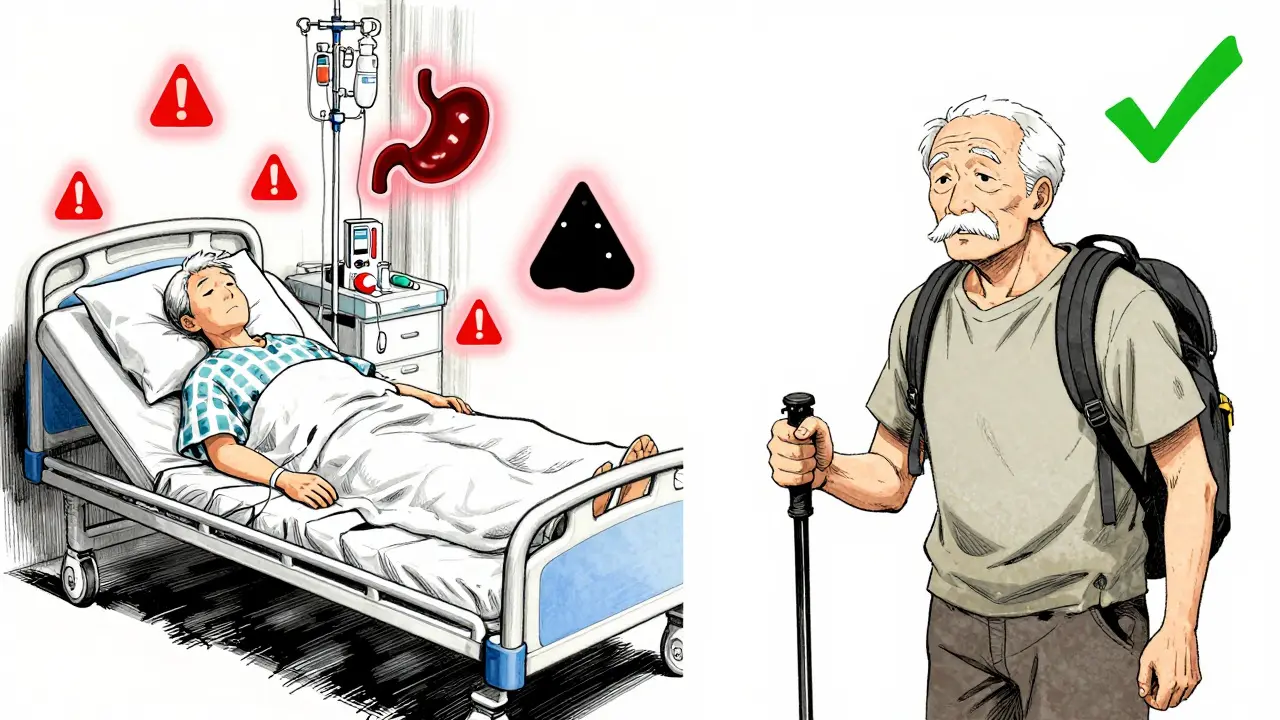
- You’re hospitalized and on steroids, especially if you’re critically ill
What Monitoring Actually Looks Like
There’s no magic test for steroid-induced ulcers. But smart monitoring is simple:- At start: Ask about past ulcers, NSAID use, and H. pylori infection. If you’ve never had an ulcer and don’t take NSAIDs, you’re low risk.
- During treatment: Pay attention to symptoms. Persistent nausea, vomiting blood, black tarry stools, or unexplained fatigue? These are red flags. Don’t ignore them.
- For high-risk patients: If you’re on both steroids and NSAIDs, a PPI like omeprazole or pantoprazole is recommended. Misoprostol is an alternative, but it causes diarrhea and isn’t safe in pregnancy.
- Endoscopy? Only if you have alarm symptoms. Routine endoscopy for steroid users without symptoms is not supported by evidence.
The Shift in Clinical Practice
Hospitals are starting to catch up. A 2021 quality project at Johns Hopkins stopped routine PPIs for patients on steroids alone. Over 12 months, they cut PPI use by 42.7% - and saw no rise in GI complications. At the University of Wisconsin, a new protocol called “Steroid-Only PPI Stewardship” cut inappropriate PPI prescriptions by 35% in just three months. Similar programs are rolling out across the U.S. and Canada. Reddit threads like r/medicine show real-world debates. One doctor wrote: “I stopped giving PPIs for steroid monotherapy after reading the Things We Do for No Reason™ article. Haven’t seen a single GI bleed in 18 months.” Another replied: “I had a patient bleed out on 60mg prednisone alone. I’m not taking that chance again.” Both are right - depending on the context. The first doctor was likely treating low-risk outpatients. The second was dealing with a hospitalized, high-risk patient.
What’s Next?
A clinical trial registered as NCT05214345 is currently comparing GI outcomes in patients on high-dose steroids with and without PPIs. Results are expected by late 2024. Meanwhile, the American Gastroenterological Association is forming a working group to update its guidelines - a sign this issue is finally getting serious attention. The bottom line? Don’t assume steroids are the villain. Look at the whole picture. If you’re on steroids alone - and not taking NSAIDs or blood thinners - your risk of an ulcer is extremely low. Routine PPIs aren’t helping you. They might even be hurting you.Frequently Asked Questions
Do corticosteroids cause stomach ulcers on their own?
No, corticosteroids alone rarely cause gastric ulcers. Large studies show no significant increase in peptic ulcer disease in patients taking glucocorticoids without NSAIDs. The risk is very low - around 0.4% to 1.8% - and often lower than in the general population. Symptoms like stomach upset may occur, but they don’t usually mean an ulcer is forming.
Should I take a PPI if I’m on prednisone?
Only if you’re also taking NSAIDs, have a history of ulcers, are on blood thinners, are hospitalized, or are over 65 with high-dose steroids. If you’re otherwise healthy and not taking NSAIDs, routine PPI use isn’t supported by evidence. Taking PPIs unnecessarily can lead to side effects like low magnesium, pneumonia, or C. diff infection.
What are the warning signs of a steroid-related ulcer?
Watch for vomiting blood (red or coffee-ground material), black or tarry stools, sudden severe abdominal pain, unexplained fatigue (which may signal anemia), or persistent nausea that doesn’t improve. These are alarm symptoms. Don’t wait - get checked immediately. Corticosteroids can mask early pain, so by the time you feel it, the ulcer may already be bleeding or perforated.
Is endoscopy needed for everyone on corticosteroids?
No. Routine endoscopy is not recommended for patients on corticosteroids without symptoms. Endoscopy should be reserved for those with alarm signs like bleeding, anemia, or persistent pain. Studies show no benefit to screening endoscopy in low-risk patients, and it carries its own risks like sedation complications or perforation.
Can I stop my PPI if I’m on steroids but not taking NSAIDs?
Yes, if you’re not taking NSAIDs, have no prior ulcer history, and aren’t in the hospital. Several hospitals have successfully discontinued routine PPIs for steroid-only patients without increasing GI complications. Talk to your doctor first - don’t stop abruptly if you’ve been on it long-term, as rebound acid reflux can occur. A gradual taper may be needed.
Why do some doctors still prescribe PPIs for steroid-only patients?
Because the old belief is hard to change. Many clinicians learned in training that steroids cause ulcers, and it’s easier to prescribe a PPI than to explain why it’s not needed. Also, fear of litigation plays a role - some doctors worry they’ll be blamed if a patient bleeds. But evidence shows the risk is minimal without NSAIDs. The tide is turning, with more institutions adopting evidence-based protocols.


